In the peer-reviewed study Composite GO/Ceramic Membranes Prepared via Chemical Attachment: Characterisation and Gas Permeance Properties, published in Membranes in 2022, researchers investigated GO/ceramic composite membranes prepared by chemically attaching graphene oxide to ceramic supports.
Macroporous α-alumina ceramic disks pressed from Baikalox® CR6 powder — 100% α-phase, d50 0.5 µm and BET 6 m2/g — provided the reproducible support platform used to compare GLYMO, APTES and PDA linkers for GO laminate assembly and gas permeance testing.
The study evaluated He, CO2 and CH4 permeance at 298.15 K, 333.15 K and 373.15 K, showing that linker chemistry affects GO stacking, interlayer spacing and transport behaviour.
CR6’s role is upstream but critical: it enables the preparation of the α-Al2O3 ceramic support on which the GO/linker architecture is built.
Why Alumina Support Design Matters in GO/Ceramic Membranes
GO/ceramic composite membranes combine a porous inorganic support with graphene oxide laminates. The support defines the surface available for chemical anchoring, the baseline pore structure before GO deposition and the mechanical stability of the membrane architecture. The study focused on Al2O3 and ZrO2 supports because ceramic membranes offer chemical, thermal and mechanical stability in conditions where polymeric membranes may be limited.
For alumina-based supports, surface hydroxylation is central. Aluminol groups on the α-Al2O3 surface provide anchoring sites for molecular linkers, which then interact with oxygenated groups on GO. The quality of this interface influences GO stacking, laminate continuity and the gas transport pathways formed after deposition.
Experimental Platform: CR6-Derived α-Al2O3 Disks
The researchers fabricated custom α-Al2O3 disks by pressing commercial Baikalox® CR6 powder in a mould, followed by sintering at 800 °C for 30 h and 1180 °C for 2 h. The resulting disks were approximately 22 mm in diameter, 2 mm thick and reported with a 0.2 µm nominal pore size. One surface was polished with SiC sandpaper before chemical functionalisation.
The study compared three linker chemistries on these CR6-derived alumina supports:
| Linker | Function | Scientific observation |
|---|---|---|
| GLYMO | Short-chain silane linker | Produced denser and more uniform GO assembly among the short-chain linkers; XPS detected 3.5 at.% Si on the Al2O3 surface. |
| APTES | Short-chain amine silane linker | Showed strong GO interaction by Raman, but XPS detected only trace Si, indicating lower surface grafting efficiency than GLYMO. |
| PDA | Long-chain polydopamine linker | Supported GO attachment through its macromolecular structure and produced larger GO interlayer spacing. |
GO laminates were deposited by dip-coating for oligo-layered membranes and by post-filtration of GO/EDA suspensions for multi-layered membranes. The membranes were characterised by XRD, Raman, ATR-FTIR, FESEM and XPS. Gas permeance was measured with He, CO2 and CH4 at 298.15 K, 333.15 K and 373.15 K, with transmembrane pressures up to 1.2 bar.
CR6 Powder Specifications
| CR6 property | Typical value |
|---|---|
| Crystalline phase | 100% α-Al2O3 |
| BET specific surface area | 6 m2/g |
| PSD d50 | 0.5 µm |
| Bulk density | 0.6 g/cm3 |
| Tapped density | 0.8 g/cm3 |
Why CR6 Was Relevant to This Alumina Support Route
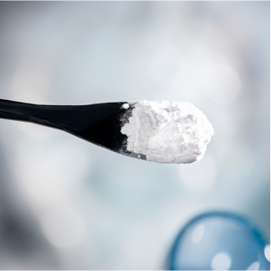 CR6 provided the controlled α-alumina powder platform from which reproducible macroporous supports were fabricated. Its α-phase, d50 of 0.5 µm and BET surface area of 6 m2/g are relevant to powder packing, sintering behaviour and the preparation of ceramic disks suitable for polishing, hydroxylation and linker grafting before GO deposition.
In the study, CR6-derived α-Al2O3 disks were reported with a 0.2 µm nominal pore size. This pore architecture cannot be attributed to particle size alone: it results from the combination of powder characteristics, pressing, sintering at 800 °C for 30 h and 1180 °C for 2 h, and subsequent surface preparation. For ceramic membrane substrate development, this is precisely why powder selection and process parameters must be considered together.
Baikowski’s CR range includes 4N alumina milled powders with controlled specific surface area and α or γ crystalline phase, with CR6 positioned as a 100% α-phase grade. Slurry and spray-dried forms can also be discussed depending on the targeted processing route.
Key Scientific Findings
1. Linker chemistry changed GO laminate assembly
Raman analysis showed ID/IG ratios of 1.14 for Al2O3 GLYMO-GO, 1.21 for Al2O3 PDA-GO and 1.61 for Al2O3 APTES-GO, compared with 1.01 for pure GO. These changes indicate structural disorder associated with chemical interaction between GO and the linkers. The study concludes that GLYMO produced denser and more uniform GO assembly among the short-chain linkers, while PDA also showed a beneficial effect due to its macromolecular structure.
2. XPS clarified why GLYMO outperformed APTES on alumina
Although APTES showed strong interaction with GO by Raman analysis, XPS detected only trace Si on the Al2O3 surface. By contrast, GLYMO-GO/α-Al2O3 showed 3.5 at.% Si, indicating more effective attachment of GLYMO on the ceramic surface. The authors associate this difference with a different anchoring mechanism for GLYMO and a higher efficiency for grafting.
3. GO interlayer spacing depended on the linker
XRD analysis showed different GO interlayer spacings depending on linker chemistry:
| Membrane | GO d-spacing | Interpretation |
|---|---|---|
| Al2O3 GLYMO-GO | 8.45 Å | Dense GO stacking on a short-chain silane linker |
| Al2O3 APTES-GO | 8.50 Å | Similar spacing, but weaker effective surface grafting on alumina |
| Al2O3 PDA-GO | 9.57 Å | Larger spacing linked to PDA’s macromolecular structure |
For membrane developers, this connects alumina surface functionalisation to GO laminate architecture. The support and linker must be engineered together; the selective layer emerges from the complete support–surface–GO system.
4. Gas transport was evaluated with He, CO2 and CH4
The study measured single-gas permeance of He, CO2 and CH4 and compared He/CO2 and He/CH4 selectivity with Knudsen selectivity ratios. These results were used to interpret pore structure, dense and loose GO domains, and gas transport mechanisms in the GO/ceramic membranes.
The demonstrated gas-separation discussion should therefore remain limited to the tested gas systems and experimental conditions. Claims on H2 purification, N2/CO2 separation, solvent nanofiltration or wastewater treatment would require additional experimental evidence.
FAQ
✅ What role did CR6 play in the GO/ceramic membrane study?
CR6 was the α-Al2O3 powder used to fabricate the macroporous ceramic disks tested in the study. The disks were prepared by pressing CR6 powder, then sintering at 800 °C for 30 h and 1180 °C for 2 h, producing supports approximately 22 mm in diameter, 2 mm thick and with a 0.2 µm nominal pore size. These supports enabled comparison of GLYMO, APTES and PDA linkers before GO deposition and gas permeance testing.
✅ Which CR6 properties are relevant when designing ceramic membrane supports?
The relevant CR6 parameters are its 100% α-Al2O3 phase, d50 of 0.5 µm, BET surface area of 6 m2/g, and density values for powder handling and pressing. These properties influence powder packing, sintering response and reproducibility of ceramic support preparation. Final pore architecture also depends on compaction, thermal cycle and surface preparation.
✅ Can alumina powder specifications be adapted for specific ceramic support targets?
For ceramic substrates, particle size distribution, specific surface area, crystalline phase and sintering behaviour are key parameters because they influence packing, densification and pore architecture. Baikowski can discuss alumina powder specifications and processing routes according to the targeted support geometry, porosity and surface treatment. Final membrane behaviour must still be validated under the customer’s own process and operating conditions.
✅ What did the study demonstrate on CR6-derived supports?
The study demonstrated that linker chemistry strongly affects GO laminate morphology, interlayer spacing and gas permeance behaviour on α-Al2O3 ceramic supports. GLYMO and PDA produced more favourable GO assemblies than APTES under the reported conditions. The work also showed that XPS, Raman, XRD and gas permeance analysis can be combined to relate surface chemistry to transport behaviour.
✅ Which gas-separation data are directly supported?
The directly tested gases are He, CO2 and CH4. The study supports discussion of He/CO2 and He/CH4 permeance and selectivity behaviour at 298.15 K, 333.15 K and 373.15 K, with transmembrane pressures up to 1.2 bar. It does not directly test H2, N2 or solvent filtration.
Conclusion
The study shows that GO/ceramic membrane behaviour depends on the complete support–surface–laminate architecture: the ceramic support, its hydroxylated surface, the molecular linker and the GO deposition route all influence gas transport response. Baikalox® CR6 provided the controlled α-alumina powder platform used to fabricate reproducible macroporous Al2O3 disks for linker-assisted GO membrane development.
For ceramic membrane R&D, the practical takeaway is that powder properties must be considered before surface functionalisation. Particle size distribution, α-phase stability and sintering behaviour help define the ceramic support on which selective GO architectures are built. Baikowski can support these early-stage specification discussions by helping R&D teams evaluate alumina powder selection, surface area, phase composition and processing requirements for ceramic substrate development.
Explore Further
→ Review Baikalox® CR6 technical data
→ Learn more on CR6 composite membrane application in the following study : A Combined Gas and Water Permeances Method for Revealing the Deposition Morphology of GO Grafting on Ceramic Membranes