How Oxide Powders Shape Ox/Ox CMC Matrices?
 For Ox/Ox CMC matrix formulation, the critical parameters are particle size < 1μm, particle size distribution, surface area, slurry viscosity, dispersion stability, sintering reactivity and controlled porosity. These properties influence how the oxide matrix penetrates the fiber architecture, consolidates during thermal treatment and supports damage-tolerant behaviour under demanding service conditions.
Baikowski supplies 4N alumina and high-purity mullite powders and slurries — with documented d50, viscosity, pH and solid loading values — as technical inputs for oxide CMC matrix.
Ox/Ox CMC Industrial Context
 Oxide/oxide ceramic matrix composites have been studied since the 1980s as a route to combine oxide fibers with oxide matrices. Their relevance for aero-engine components — such as combustion liners, exhaust cones and thermal protection systems — comes from their ability to address environments where oxidation, hot gases, corrosion, erosion, thermal gradients and mechanical loading occur together.
In these systems, the matrix is not a passive filler. A controlled matrix formulation can support crack deflection, porosity management and more reliable composite behaviour under severe operating conditions.
Why Oxide Properties Matter?
In Ox/Ox CMC processing, the ceramic matrix is commonly introduced through slurry-based routes such as impregnation, infiltration or coating. The slurry must distribute through the fiber architecture, remain stable during processing and consolidate into a controlled microstructure during thermal treatment.
| Categories | Parameters | Why it matters for Ox/Ox CMC matrix formulation |
| Primary matrix formulation | Particle size distribution | Influences slurry penetration, matrix homogeneity and the risk of local heterogeneities during infiltration or coating. |
| Slurry viscosity | Governs processability during impregnation, coating or infiltration and must be adapted to the fiber architecture. | |
| pH and dispersion stability | Conditions compatibility with binders, dispersants and aging behaviour, supporting batch-to-batch reproducibility. | |
| Densification behaviour | Must be compatible with fiber preservation while providing sufficient matrix cohesion. | |
| Microstructure control | Controlled porosity | Supports the damage-tolerant architecture expected from Ox/Ox CMC systems. |
| Powder reactivity | Specific surface area | Relevant to sintering reactivity and matrix consolidation, in combination with particle size, formulation and thermal cycle. |
| Chemistry control | Phase purity | Helps maintain predictable matrix chemistry and sintering behaviour. |
| Dopant chemistry | Can be used to explore microstructure control, grain-growth limitation or matrix modification, depending on the target system. | |
| Process efficiency | Solid loading | Influences the amount of matrix introduced per processing step and the overall formulation strategy. |
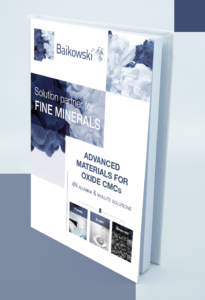
For a deeper dive into advanced materials for oxide CMCs — and for insights into what makes an outstanding matrix and how a slurry can be formulated for high-quality Ox/Ox CMCs — explore the dedicated white paper:
Alumina & Mullite Solutions for CMC Applications White Paper
Baikowski Solutions for Ox/Ox CMC Matrix Formulation
Baikowski provides several oxide-based routes for Ox/Ox CMC matrix development such as:
| Solutions | Key documented properties | Comments |
|---|---|---|
| SM8 | SSA ≈ 10 m²/g; d50 ≈ 0.12 µm; bulk density 0.8 g/cm³; tapped density 1.1 g/cm³ | Fine 4N α-alumina powder route. |
| BA15-PSS | pH 9–10; 50 wt% solid content; slurry density 1.6 g/cm³; Sedigraph d50 0.11 µm | Ready-to-use 4N α-alumina slurry. |
| Mullite | 100% mullite; high chemical purity; d50 < 0.2 µm; specific surface around 35 m²/g; available as slurries and spray-dried powders | High-purity nanosized mullite. |
| SLAz | High-purity fine α-alumina; customizable zilight® nano-zirconia ratio; pH stability range 4–10; viscosity η < 0.3 Pa·s | Doped alumina slurry designed to control alumina grain growth while maintaining dispersion homogeneity and processability through low viscosity and broad pH stability. |
See our 4N alumina & mullite solutions for CMCs
FAQ
✅ What should R&D teams specify before selecting an Ox/Ox CMC matrix powder or slurry?
Useful parameters include the target consolidation temperature, acceptable porosity range, fiber system, processing route, binder or dispersant chemistry, pH constraints, required particle size distribution and any dopant or secondary-phase requirements. Defining these points early helps identify the most relevant oxide solutions.
✅ How does particle size distribution influence Ox/Ox CMC matrix formulation?
Particle size distribution affects slurry penetration into the fiber architecture, matrix homogeneity and the risk of local defects after thermal treatment. Submicronic particles are relevant for matrix formulation. Not only the d50, but also the d90 value and agglomeration behaviour matter because coarse particles can disturb infiltration or create local heterogeneities.
 ✅ Which slurry parameters matter most for Ox/Ox CMC processing?
 ✅ Which slurry parameters matter most for Ox/Ox CMC processing?
The key slurry parameters are
- particle size and particle size distribution,
- viscosity,
- pH,
- dispersion stability
- compatibility with binders or dispersants.
Aging behaviour is also important because a slurry that changes over time can introduce process variability.
✅ Can Baikowski solutions be customised for CMC development?
Baikowski solutions can be customised according to the targeted matrix chemistry, processing route and microstructural objectives. Customisation may involve the adjustment of doping level or chemical composition, the use of sintering additives, the integration of nanoparticles, or the design of mixed oxides such as alumina/zirconia systems for specific matrix requirements.
Product customisation can also include particle size distribution and SSA control, binder-free spray-dried powders to improve the handling of submicronic powders, concentrated slurries with solid loading up to 65 wt%, and functionalised powders for organic solvent-based processing.
MgO-doped alumina is another example of dopant chemistry used to investigate microstructure stability after thermal exposure.
→ Read the MgO doped alumina for Ox/Ox CMC article and scientific publication.
Conclusion
For Ox/Ox CMC matrix development, the starting oxide powder or slurry is a primary formulation variable. Particle size and particle size distribution, surface area, phase purity, slurry stability and dopant chemistry influence how the matrix is processed, consolidated and evaluated. These key parameters can be discussed and customised with Baikowski R&D teams according to the targeted process route and application constraints.
As aerospace supply chains place increasing demands on material traceability and environmental documentation, Baikowski’s Life Cycle Assessment work and decarbonization initiatives on alumina manufacturing routes add a further dimension of supply-chain transparency.
Beyond aerospace, Ox/Ox CMC development is also relevant to energy, defense and industrial high-temperature sectors.
The same formulation logic applies across these domains: controlled oxide powder → reproducible matrix → defined microstructure.
For further information:
👉 Discuss with us
👉 download our ox/oc CMC powder White Paper