
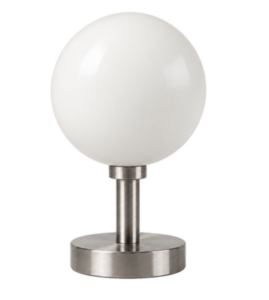
 Ceramic precision balls and reference spheres provide contact surfaces or reference geometries for metrology and dimensional control. Their geometry and surface integrity are therefore central to their measurement function. Manufacturing these components requires control of sintering shrinkage, residual porosity and microstructure before precision finishing.
Baikowski® supplies 3N and 4N high-purity α-alumina powders in binder-free spray-dried and Ready-to-Press forms. MgO-doped formulations are also available for specific densification and grain-growth requirements.
What Alumina Powder Characteristics Matter for Precision Ceramic Balls?
Powder selection should address green-density uniformity, densification and microstructure control.
Uniform Compaction for Dimensional Consistency
Dimensional consistency starts with powder filling and compaction. Flowability supports even die filling, while granule breakdown during pressing allows particles to rearrange and consolidate into a uniform compact. The resulting green density distribution influences how the component shrinks during sintering.
The dimensional consequences of non-uniform compaction were demonstrated by Lu and Lannutti. In spray-dried alumina compacts, they found that initial density gradients adversely affected dimensional tolerances after sintering. Their results underline the importance of green-density uniformity for dimensional control before precision machining. [1]
Homogeneous Microstructures for Precision Finishing
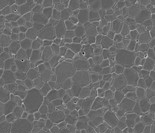
Compaction also sets the particle arrangement from which densification proceeds. Uniform packing and controlled agglomeration help limit local differences in shrinkage and the formation of residual defects during sintering.
The objective is both dimensional consistency and a dense, homogeneous microstructure before finishing.
Purity, Dopants and Grain-Growth Control
Impurity levels and dopant distribution influence grain growth during sintering.
Controlling powder composition helps limit microstructural heterogeneity, while MgO doping provides an additional means of controlling grain growth. The dopant concentration is selected according to the alumina grade and firing cycle.
Selecting Alumina Powders for Precision Components in Metrology
Baikowski® helps manufacturers select powders and formulations for uniaxial pressing, cold isostatic pressing, ceramic injection molding and suspension-based forming. These include BA15 and PBA6 spray-dried grades, available in binder-free and Ready-to-Press forms.
BA15-W and BA15-WL: 4N Alumina Formulations
BA15-W | Baikalox® is a 4N, 100% α-alumina with a typical specific surface area of 17 m²/g. BA15-based formulations offer high sintering reactivity for manufacturers targeting high density at relatively low firing temperatures. A binder-containing version, BA15-WL, is available for Ready-to-Press use.
For both solutions, MgO-doped and customised dopant formulations are available to match densification and grain-growth requirements.
PBA6-WL and PBA6-W: 3N Alumina Formulations
 PBA6-WL | Baikalox® is a 3N Ready-to-Press α-alumina with a BET specific surface area of 4 m²/g. It is designed for controlled shrinkage, high sintering reactivity and reproducible processing performance.
PBA6-W is the binder-free spray-dried option for manufacturers preparing their own formulation.
PBA6-WL contains 500 ppm MgO. Its sintering map shows almost no grain growth during densification up to 92% relative density, followed by controlled growth during the final stage.
Download the PBA6-WL technical leaflet
Technical Support for Precision Ceramic Manufacturing
Our support covers powder selection, formulation and implementation. Through our customization capabilities, we can adapt composition, dopants, particle-size distribution, specific surface area, flowability and sinterability to your process.
For alumina–zirconia composites, our ZTA solutions offer additional formulation options.
Discuss your metrology material requirements with Baikowski®.
[1] P. K. Lu and J. J. Lannutti, 2000, “Density gradients and sintered dimensional tolerance in compacts formed from spray-dried alumina,” Journal of the American Ceramic Society, 83(6), 1393–1398. DOI: 10.1111/j.1151-2916.2000.tb01399.x.